top of page
Susuwatari
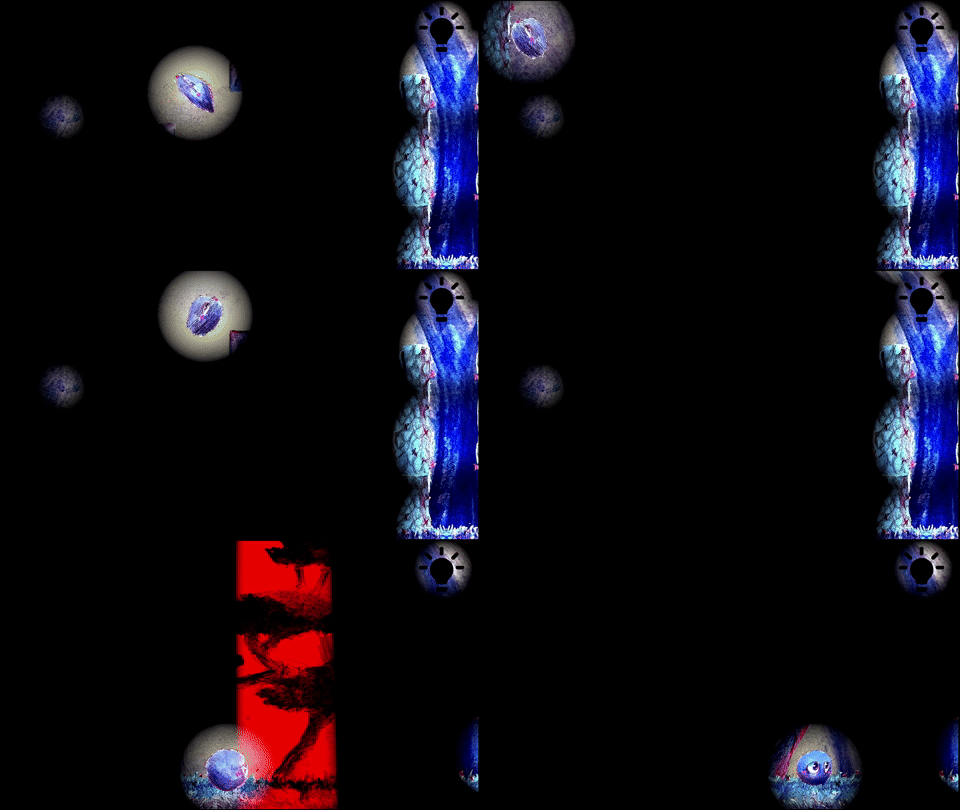
Susuwatari is a one button game where you playa little ball of soot trying to get throught a dark forest in the dark
I created this game entirely on my own, only receiving help from a friend who is an illustrator for the graphics. The challenge was to learn how to conceptualize an effective game with demanding instructions and quickly prototype it using a game engine. Here's a detailed look at everything I did :
Game design
For the game design, the real challenge was to offer sufficiently diverse gameplay with a single button to provide a wide range of situations. I initially started with a stealth-based gameplay model, which proved frustrating and limited. After some research, I decided to introduce a memory skill requirement: the player can only see the entire level before the game begins, and then must retrace it entirely in the dark. This idea is complemented by the concept of enemy lights that must be avoided, which require reflexes and precise timing.
.png)
Conception of core gameplay
However, after development, I noticed quality control errors that led to a less clear understanding of the game. First, the metrics were poorly configured, and the player ended up being far too large for the world they were exploring. Metrics similar to those in Super Meat Boy would have been much more appropriate.
The second problem was the illustrations. Not having worked with a game artist and having little experience at the time, I didn't specify details that could have made each scene clearer. For example, adding outlines to each character, reworking the parallax and shadows so the background wouldn't overwhelm the artwork. These are details that allowed me to improve in the future.
.png)
task management and conception of new features
Level Design
For the level design, I didn't have many levels to create. In a short period of time, I allowed myself to experiment with all the different possibilities offered by the memory skill with platforming. Therefore, I didn't immediately integrate enemy lights and instead decided to make a simple tutorial, given that players initially rushed through without memorizing the terrain.
Later, after some experimentation, I made greater use of wall bounces. Initially used for turning around, they became a wall jump mechanic. I also added some visual cues with lights in certain areas to make some scenes easier to understand after a few playtests.

conception of a few situations
Programmation
Having only visual scripting knowledge, I tackled the task of programming the game, trying to make it as readable as possible. I used state graphs to better manage the transitions and states of the playable scene. The challenge also lay in animating a soot ball, managing bugs that could arise from scene-to-scene transitions, and even dealing with the numerous collision problems caused by faulty metrics.


Musics and sound design
For the sound design and music, I opted for a minimalist aesthetic. Oscillating between melancholy and mystery, I wanted the audience to feel as lost as that soot ball in the vast, dense forest, and to sense in the atmosphere the fear the character might have felt.
Most of the sound effects were designed to be pleasant to listen to, except for the death sound effect. It's a slow, derailing violin followed by a fade to black as the sootball is captured. Besides creating confusion, it disrupts the game's established order and adds intrigue.
Susuwatari Main Theme 1venusb0y
00:00 / 01:05

Trailer


bottom of page